


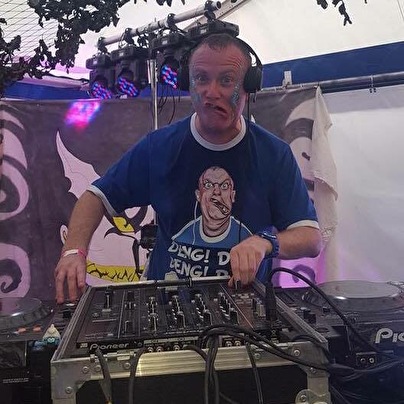
| Naam | Glenn Petersen |
| Functie | 323× DJ, producer |
| Geslacht | man |
| Alias | Xmurf |
| Herkomst | Verenigd Koninkrijk 🇬🇧 |
| Genres | classics, frenchcore, hardcore, speedcore, terror hardcore |
| Links |       |
| Leden | +  DJ_smurfGGM (13 okt 2015) DJ_smurfGGM (13 okt 2015) |
Biografie
·Taking influences from hip hop, old-school, early Dutch hardcore, pop music, and WWE Wrestling, Smurf's energetic DJ sets—accompanied by wild dancing behind the decks—have been moving (and often confusing) dance floors around the world since 1992.
Smurf describes the music he plays as "a reflection of my personality. I feel like the music I am playing is coming from my brain, into the mixer, and out through the speakers." The self-confessed "Greatest Entertainer on Earth" doesn't play or make music to impress his peers, colleagues, or friends; "it's party music for party people." Whether you like the music or not, a DJ Smurf show is always an unforgettable experience. He has even fallen off stage and broken his leg in the name of entertainment!
Smurf, affectionately known as The Small Blue Machine, began his love affair with alternative music back in 1981, at the tender age of nine. Music was always playing in the Smurf household from an early age. Tired of every song on the radio and TV being about love, a track by Adam & The Ants called "Stand & Deliver" grabbed his attention. It wasn't about love, but about a highwayman robbing people. This alternative track started his musical journey from new wave/pop rock to electro, to hip hop, to acid, to European techno, to gabba, and what is now termed terror and Frenchcore, and back to techno.
During the '80s, Smurf spent his time trainspotting, break-dancing, and listening to Jeff Young's Big Beat on Radio 1 on Friday nights. He recorded the latest hip hop, house, and acid music onto cassettes to listen to while doing his weekly paper round. The money from that was spent on two 12-inch records or a compilation album at the weekend.
In 1990, he got a job, and every spare penny was spent on the latest Dutch, German, and Belgian import 12-inch records. His 18th birthday came in November 1990. He bought proof-of-age ID (as he looked about 12) and began attending warehouse parties, clubs, and raves all around the UK almost every weekend in the early '90s.
The first set of turntables was bought in 1990. On New Year's Eve 1991, while attending a rave night at a club called Walkers in Newcastle, Smurf was asked to fill in for a DJ who didn't turn up. This was his first live set in front of people—very scary. The set has been reproduced here: https://soundcloud.com/smurfggm/dj-smurf-walkers-newcastle-england-31121991.
By 1993, music had gotten a lot faster and harder. Breakbeat and jungle had taken over the UK, yet Smurfy was more interested in the harder 4/4 sounds coming from the continent and the USA. The first "gabber" (or "gabba" as we called it) records started to filter into UK record shops, with the likes of The Euromasters, Rotterdam Records, and Ruffneck Records leading the way. Hundreds of pounds were spent every week on records with those big, hard, distorted 909 kick drums and insane samples.
Lots of tapes were recorded and given out in Bass Generator Records in Newcastle and at various events around the region. In 1994, his big break came. Lenny Dee was booked to play at a Judgement Day event, and Smurf was added to the lineup. The set was recorded to cassette with Lenny Dee on one side and became very popular around the North East and Scotland. Check the full set here: https://soundcloud.com/smurfggm/dj-smurf-judgement-day-whitley-bay-england-24031994.
Bookings—and a later residency—at what Smurf describes as "the greatest club ever," Nosebleed in Scotland, soon followed, as well as bookings around the UK. The Judgement Day events got bigger, and the Geordie Gabba Mafia was formed.
Not sticking to only playing the hardest, fastest gabba tracks around at the time, Smurf would drop random pop records into sets that strangely seemed to work. If the dance floor couldn't dance to the fast-paced music, they would be amused with crazy dancing behind the decks. "If I can't make them dance, I'll make them smile" is an old quote that is often brought up.
DJing eventually led to producing, with releases on Hard of Hearing, Strike, and Killout Records from 1997 onwards.
In 2000, Smurf was invited to his first gig outside the UK at the legendary Nordcore party in Hamburg, Germany. More gigs followed in Germany, Switzerland, USA, Canada, Italy, and Belgium, but it was a small party in a bar in Holland that led to his biggest break of all.
In early 2004, he was invited to play at friends Kit Williams/The Rapist's birthday party in a small bar in Haarlem, Holland. This was on a Sunday evening. He played a usual set of fun-filled terror tracks accompanied with crazy dancing to about 10 people. Little did he know the guy who made the lineups for Thunderdome—the biggest and most famous hardcore party in the world—was in attendance.
A few weeks later, he got a call that went something like: "I liked the music you played and how you interacted with the crowd. I want you to do the same for the last hour at Thunderdome in December and send people home happy." Thunderdome came, and he closed the party in the huge second area in Jaarbeurs in Utrecht. What an experience!
Following that performance, bookings came in thick and fast for events such as Masters of Hardcore, Decibel, Hellbound, Ground Zero, BKJN, Nightmare Outdoor, Megarave, and many other great parties. Around this time, Smurf became one of the most popular terror artists in Holland.
In 2006, after five years of hibernation, Smurf resurrected the mighty Judgement Day events and brought a number of European hardcore artists to the UK for the first time, including Angerfist, Endymion, D-Passion, The Speedfreak, Sonic Overkill, Peaky Pounder, Day-Mar, Noisekick, and Art Of Fighters.
GGM Raw Records was launched in 2007, and five vinyl releases were produced.
Since then, Smurf has been producing tracks on his own GGM and Deng Deng Hardcore digital labels, as well as having releases on This Is Terror, CSR, BKJN Music, Social Technology, and Footworxx. He has kept to his unique style of playing and making records for the people on the dance floor.
In 2011 and 2015, Smurf took the #DENG down under to Australia, performing in Sydney and Perth on both occasions.
Back in the UK, he promotes the Nocturnal Wizards events and co-promotes the Distorted parties in Newcastle, as well as having a helping hand in other events around the UK.
On the 25th anniversary of his first full gabber set in a club (Judgement Day in 1994), Smurf announced that he will no longer be making or playing new music as "DJ Smurf". Bookings as "DJ Smurf" will only be for old-school/early hardcore/early terror. He will continue to produce non-gimmicky, fun music as Xmurf, but only on a casual basis. He will continue to play techno as Viktor Van Stroomf.
Smurf describes the music he plays as "a reflection of my personality. I feel like the music I am playing is coming from my brain, into the mixer, and out through the speakers." The self-confessed "Greatest Entertainer on Earth" doesn't play or make music to impress his peers, colleagues, or friends; "it's party music for party people." Whether you like the music or not, a DJ Smurf show is always an unforgettable experience. He has even fallen off stage and broken his leg in the name of entertainment!
Smurf, affectionately known as The Small Blue Machine, began his love affair with alternative music back in 1981, at the tender age of nine. Music was always playing in the Smurf household from an early age. Tired of every song on the radio and TV being about love, a track by Adam & The Ants called "Stand & Deliver" grabbed his attention. It wasn't about love, but about a highwayman robbing people. This alternative track started his musical journey from new wave/pop rock to electro, to hip hop, to acid, to European techno, to gabba, and what is now termed terror and Frenchcore, and back to techno.
During the '80s, Smurf spent his time trainspotting, break-dancing, and listening to Jeff Young's Big Beat on Radio 1 on Friday nights. He recorded the latest hip hop, house, and acid music onto cassettes to listen to while doing his weekly paper round. The money from that was spent on two 12-inch records or a compilation album at the weekend.
In 1990, he got a job, and every spare penny was spent on the latest Dutch, German, and Belgian import 12-inch records. His 18th birthday came in November 1990. He bought proof-of-age ID (as he looked about 12) and began attending warehouse parties, clubs, and raves all around the UK almost every weekend in the early '90s.
The first set of turntables was bought in 1990. On New Year's Eve 1991, while attending a rave night at a club called Walkers in Newcastle, Smurf was asked to fill in for a DJ who didn't turn up. This was his first live set in front of people—very scary. The set has been reproduced here: https://soundcloud.com/smurfggm/dj-smurf-walkers-newcastle-england-31121991.
By 1993, music had gotten a lot faster and harder. Breakbeat and jungle had taken over the UK, yet Smurfy was more interested in the harder 4/4 sounds coming from the continent and the USA. The first "gabber" (or "gabba" as we called it) records started to filter into UK record shops, with the likes of The Euromasters, Rotterdam Records, and Ruffneck Records leading the way. Hundreds of pounds were spent every week on records with those big, hard, distorted 909 kick drums and insane samples.
Lots of tapes were recorded and given out in Bass Generator Records in Newcastle and at various events around the region. In 1994, his big break came. Lenny Dee was booked to play at a Judgement Day event, and Smurf was added to the lineup. The set was recorded to cassette with Lenny Dee on one side and became very popular around the North East and Scotland. Check the full set here: https://soundcloud.com/smurfggm/dj-smurf-judgement-day-whitley-bay-england-24031994.
Bookings—and a later residency—at what Smurf describes as "the greatest club ever," Nosebleed in Scotland, soon followed, as well as bookings around the UK. The Judgement Day events got bigger, and the Geordie Gabba Mafia was formed.
Not sticking to only playing the hardest, fastest gabba tracks around at the time, Smurf would drop random pop records into sets that strangely seemed to work. If the dance floor couldn't dance to the fast-paced music, they would be amused with crazy dancing behind the decks. "If I can't make them dance, I'll make them smile" is an old quote that is often brought up.
DJing eventually led to producing, with releases on Hard of Hearing, Strike, and Killout Records from 1997 onwards.
In 2000, Smurf was invited to his first gig outside the UK at the legendary Nordcore party in Hamburg, Germany. More gigs followed in Germany, Switzerland, USA, Canada, Italy, and Belgium, but it was a small party in a bar in Holland that led to his biggest break of all.
In early 2004, he was invited to play at friends Kit Williams/The Rapist's birthday party in a small bar in Haarlem, Holland. This was on a Sunday evening. He played a usual set of fun-filled terror tracks accompanied with crazy dancing to about 10 people. Little did he know the guy who made the lineups for Thunderdome—the biggest and most famous hardcore party in the world—was in attendance.
A few weeks later, he got a call that went something like: "I liked the music you played and how you interacted with the crowd. I want you to do the same for the last hour at Thunderdome in December and send people home happy." Thunderdome came, and he closed the party in the huge second area in Jaarbeurs in Utrecht. What an experience!
Following that performance, bookings came in thick and fast for events such as Masters of Hardcore, Decibel, Hellbound, Ground Zero, BKJN, Nightmare Outdoor, Megarave, and many other great parties. Around this time, Smurf became one of the most popular terror artists in Holland.
In 2006, after five years of hibernation, Smurf resurrected the mighty Judgement Day events and brought a number of European hardcore artists to the UK for the first time, including Angerfist, Endymion, D-Passion, The Speedfreak, Sonic Overkill, Peaky Pounder, Day-Mar, Noisekick, and Art Of Fighters.
GGM Raw Records was launched in 2007, and five vinyl releases were produced.
Since then, Smurf has been producing tracks on his own GGM and Deng Deng Hardcore digital labels, as well as having releases on This Is Terror, CSR, BKJN Music, Social Technology, and Footworxx. He has kept to his unique style of playing and making records for the people on the dance floor.
In 2011 and 2015, Smurf took the #DENG down under to Australia, performing in Sydney and Perth on both occasions.
Back in the UK, he promotes the Nocturnal Wizards events and co-promotes the Distorted parties in Newcastle, as well as having a helping hand in other events around the UK.
On the 25th anniversary of his first full gabber set in a club (Judgement Day in 1994), Smurf announced that he will no longer be making or playing new music as "DJ Smurf". Bookings as "DJ Smurf" will only be for old-school/early hardcore/early terror. He will continue to produce non-gimmicky, fun music as Xmurf, but only on a casual basis. He will continue to play techno as Viktor Van Stroomf.
Uitgaansagenda Smurf
Statistieken
| 313 | · | optredens |
| geen | · | in de toekomst |
| 313 | · | in het verleden |
| 10677 | × | bekeken sinds 4 april 2013 |
| 12622 | | fans |
| 53 | · | foto's tijdens optreden |
| 18 | · | foto's als lid: DJ_Smurf_GGM_UK |
| 14 | · | video's |
| 75 | · | opmerkingen |
| 174 | · | waarderingen |
| geweldig | · | stemresultaat (439 stemmen) |
